
Safety First
The First Ten Minutes
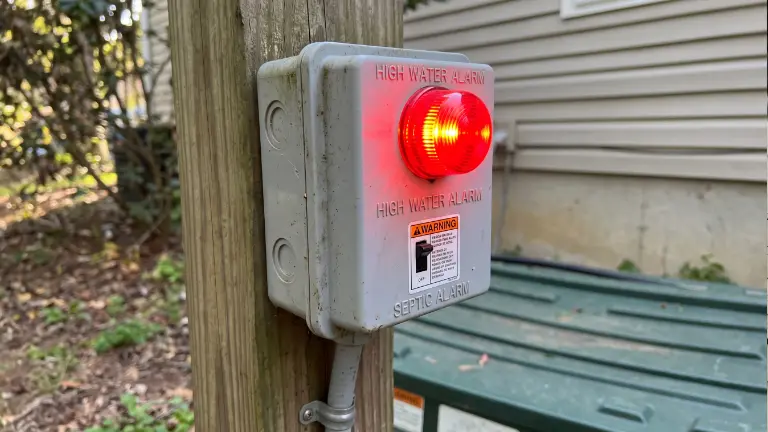
- Silence the horn, but leave the alarm powered. The red light stays on. That's your reminder the problem isn't fixed.
- Check the pump breaker. Look for the one labelled septic, effluent or pump. If it's tripped, reset it once. If it trips again, leave it off and call us.
- Check the GFCI outlet, if your pump plugs into one.
- Cut water to almost nothing. No laundry, dishes or showers. Flush only when you have to.
- Stay out of the tank. The EPA says only trained people should clean or repair septic tanks, because they can hold dangerous gases (EPA).
If the reset worked, you'll hear the pump start. If the light goes out within a couple of pump cycles and stays out, you've likely found it. Call us anyway if it was the breaker. They don't usually trip for no reason.
The Basics
What the Alarm Means on Your Kind of System
A septic alarm going off means different things depending on what's buried in your yard. If you're not sure what you have, the slip from your last pump-out usually says.
Septic tank with a pump chamber
Some in-ground systems can't drain to the field by gravity, so liquid leaving the septic tank flows into a second tank with a pump. One float turns the pump on and off. A higher float runs the alarm. When that one lifts, the pump has stopped emptying the chamber: it's failed, a float is stuck, or it's lost power.
Mound system
Every mound has a pump. The EPA's mound fact sheet says all of them need pumps or siphons (EPA mound fact sheet). So a mound pump alarm nearly always traces back to the dosing chamber: the pump, the floats, the controls or the power. Now and then it's clogged pipes inside the mound. Our guide to how a mound septic system works shows the full layout.
Holding tank
A holding tank doesn't drain anywhere. It stores every gallon until a pumper empties it. Wisconsin code says a holding tank must be serviced at least when the wastewater reaches one foot below the inlet pipe (SPS 383.54; Wisconsin DSPS). The alarm tells you it's getting close to that line. It usually isn't a breakdown. It's a pump-out that's due now, and waiting won't make it go away.
Effluent filter alarm
Some tanks have an alarm on the outlet filter, which means the filter is plugging up. The University of Minnesota's septic program says alarms on pumps and filters "must be attended to immediately" (University of Minnesota).
Warning Signs
What Usually Sets It Off
| Cause | What you'll notice | Can you handle it? |
|---|---|---|
| Tripped breaker or GFCI | Pump silent, alarm light on | Yes. Reset once |
| A heavy water day | Alarm after back-to-back laundry or guests, then it clears | Yes. Spread water use out |
| Power outage | Alarm when power returns, because the chamber kept filling | Usually. Go easy on water while the pump catches up |
| Stuck float or failed pump | Breaker on, pump never starts, level keeps rising | No. Pumps and controls often need replacing after about 10 to 20 years (EPA) |
| Plugged effluent filter | Alarm, slow drains through the house | We'd rather clean it. It means opening the tank |
| Clear water getting in | Alarm after heavy rain or spring thaw, pump running a lot | Partly. Keep roof drains and sump discharge away from the system (EPA). Leaks into a tank need a repair |
| Frozen line or chamber | Winter, pump running and nothing moving | No. Don't add antifreeze or salt, and don't leave water running to thaw it (University of Minnesota) |
| Holding tank is full | Holding tank systems only | Call for a pump-out |
Owner Tips
Can You Still Use Water?
With a septic alarm going off, you can use a little. On a pump tank or mound, the alarm float sits above the level where the pump normally kicks on, so there's some room left when the alarm first sounds. How much depends on the chamber size and the float setting. We won't give you a number of hours, because it's different at every house and a wrong guess ends with sewage in the basement.
Until someone has looked at it, use toilets only and flush as little as you can. If your water softener drains into the septic system, put it in bypass. Fix a running toilet right away.
On a holding tank, the space above the alarm is there to get you through until the pumper arrives, not to keep living normally.
Warning Signs
Call Now, or Can It Wait Until Morning?
Call right away about a septic alarm going off, even at night, if:
- sewage is coming up in a floor drain, tub or the lowest toilet
- the breaker tripped again after one reset
- the alarm is still on after a few hours of almost no water use
- you see wet ground or smell sewage at the tank or mound
- it's a holding tank
Sewage backing up into a house or reaching the ground surface counts as a failing system under Wisconsin law (Wis. Stat. 145.01(4m)). Our emergency septic service page covers those calls.
It can probably wait for business hours if the alarm came on after a heavy laundry day, cleared on its own, and every drain works. Book a look anyway. An alarm that comes and goes is a pump or float on its way out, and those are easier to replace on a weekday afternoon than in a January snowstorm.
Prevention
Keeping It From Happening Again
If a septic alarm going off has become a regular thing at your place, it's usually a worn part or too much water at once.
- Have the pump side checked at service time. Wisconsin's standard mound management plan lists pumps, floats, switches, controls and alarms among the inspection items (Wisconsin DSPS mound management plan). Your county's maintenance program tracks when service is due (Wisconsin DSPS).
- Keep solids out of the pump chamber. Sludge that slips past a full tank clogs pump intakes and mound pipes. See how to tell when your tank needs pumping.
- Ask about backup power if your power goes out often. The EPA lists standby power for the pump as a way to cut the risk of mound trouble (EPA mound fact sheet).
- Replace an aging pump before it quits. A planned septic repair beats a breakdown. Mound owners, see mound system repair.
Nearby: our Little Chute emergency septic repair page covers night-time alarms and frozen lines, and Harrison holding tank pumping covers scheduled pump-outs.
FAQ
Septic Alarm Questions
How long can I go with the septic alarm going off?
There's no safe number for every house. The reserve depends on tank size and float setting. Cut water to the minimum and get it looked at the same day if the alarm doesn't clear.
Why does my septic alarm keep going off and then stop?
Usually a sticking float, a pump starting to fail, or bursts of heavy water use. If it happens after rain or snowmelt, extra water may be getting into the tank. Get it checked before it turns into an alarm that stays on.
Why is my septic alarm going off after a power outage?
The pump couldn't run while the house kept sending water to the chamber. Go easy on water for a few hours. If the alarm is still on after that, the pump or a float may have a problem.
Read Next