
The Basics
What a Holding Tank Is
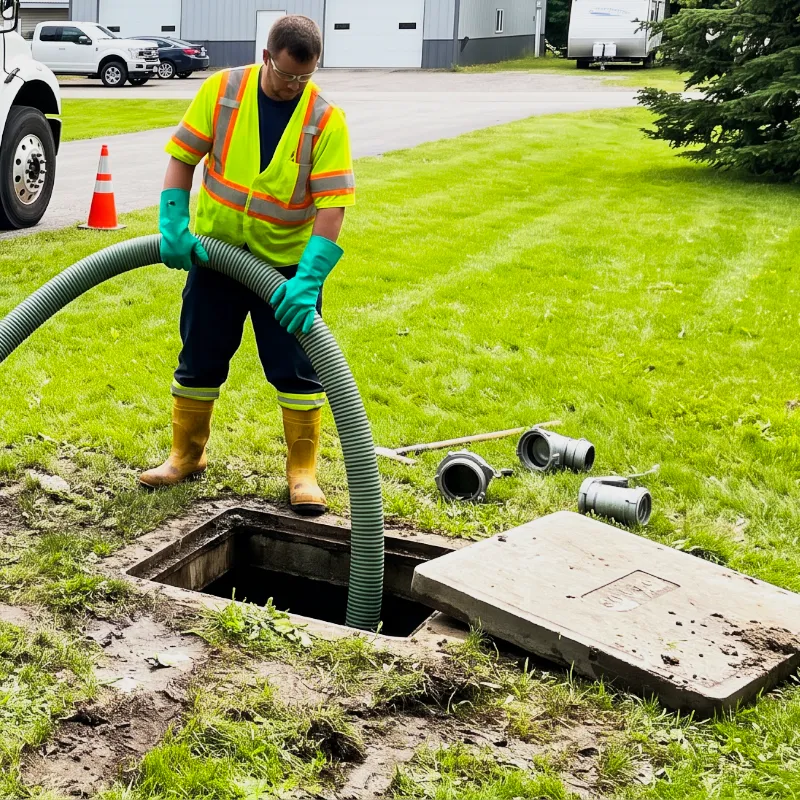
A holding tank is a sealed tank that stores all of a building's wastewater until it is pumped. Unlike a septic tank, it has no drain field or mound and treats nothing. It's used where the site can't support a treatment system, which is why it fills far faster: every gallon you use ends up in the tank.
Local Rules
The Rules for Holding Tanks in Wisconsin
- Pump when full. Holding tanks must be pumped whenever they are full (when the wastewater reaches one foot below the inlet), not on a three-year cycle (SPS 383.54).
- Management plan. Wisconsin's standard holding tank management plan sets out what the owner must do, including inspecting the alarm and other electrical components every three years (Wisconsin DSPS holding tank management checklist).
- Servicing contract. A holding tank pumped more than once a year needs one; the next section explains it.
- Reporting. Each servicing is reported to the county within 30 days (SPS 383.55); your county may set its own reporting format.
Servicing Contracts
Holding Tank Servicing Contracts in Wisconsin
A holding tank servicing contract is a written agreement between the tank's owner and a licensed pumper to service the tank for as long as it's in use. Some counties also have the owner sign a separate holding tank agreement with the county itself.
Who requires one
The state does. If the management plan calls for servicing a holding component every 12 months or less, the owner must keep a contract with a certified septage servicing operator (SPS 383.52). Any holding tank pumped more than once a year falls in that group.
Counties handle the paperwork, and each does it its own way:
- Brown County lists a holding tank agreement, a holding tank servicing contract and a form to cancel an agreement among its POWTS documents, available from the Zoning office (Brown County forms).
- Winnebago County has owners sign a holding tank agreement with the county and file the servicing contract with the Zoning Office before a holding tank permit is issued (Winnebago County Code, Chapter 16).
- Calumet County wants a new contract on file within 10 business days if you switch to a pumper who isn't named on the current one (Calumet County Code, Chapter 74).
- Outagamie County Development & Land Services administers sanitary systems; ask it what it needs on file (Outagamie County).
What the contract covers
County forms differ in the details. The Winnebago and Calumet contract forms name the owner and the pumper, and have the pumper service the tank and report each servicing to the county (Winnebago County servicing contract; Calumet County servicing contract). Winnebago's ordinance lists water meter readings among what those reports include. Calumet's contract stays in effect until the owner or the pumper ends it.
How pumping frequency is set
The code sets the latest point: when wastewater reaches one foot below the inlet, the tank must be serviced (SPS 383.54). The high-water alarm warns you it's close. Scheduled holding tank pumping works back from that point, using the tank size and how much water goes in, so the truck arrives before the alarm does.
How reporting works
The owner, or the owner's agent, reports each servicing to the county within 30 days, in the manner the county asks for (SPS 383.55). We file that report for you after each pump-out. In Calumet County you can look up what's on file in its online Ascent records (Calumet County Sanitation).
How It Works
How Scheduled Holding Tank Pumping Works
- Set the interval. We use tank capacity, household or business size and water use (or meter readings where installed) to set the first schedule.
- Pump before the alarm. We come on the calendar, so you never ration water.
- Check every visit. Alarm, float, lid, riser and signs of leaks or groundwater getting in.
- Report and record. Each pump-out goes to the county and onto your service history.
- Adjust. If the tank fills faster than expected, we help track down the cause: running toilets, leaks, sump or roof drains connected by mistake.
If your water use changes, so does the interval. Before we change anything, we talk through what it means for the number of visits in a year and what they'll cost.
Typical Costs
What Does Holding Tank Pumping Cost in Wisconsin?
With a holding tank, the yearly total matters more than any single pump-out, and for a busy household it can top $1,000 a year. Kenosha County figures a family of four with a 3,000-gallon tank would need it pumped about every 17 days, and says yearly pumping costs could exceed $1,000 even with careful water use (Kenosha County).
If you're putting in a new holding tank, the county permit is a fixed, published fee:
| County | Sanitary permit, holding tank | Plan approval |
|---|---|---|
| Outagamie (2026) | $950 | $150 |
| Calumet | $500, including the $100 state fee | $100 (one- and two-family homes) |
Sources: Outagamie County 2026 fee schedule; Calumet County sanitary application. Brown and Winnebago counties set their own fees.
What moves the yearly cost of holding tank pumping:
- Water use. Every gallon that goes down a drain gets pumped and hauled, so leaks and running toilets cost money on every visit.
- Tank size. A bigger tank means fewer trips, but each one moves more.
- Disposal. The treatment plant charges the hauler for each load by volume (Madison Metropolitan Sewerage District hauler rates, for example).
- Access. Buried lids or a long hose run add time to each visit; risers bring the lids up to grade.
These are typical Wisconsin figures from county sources, not our price list. The cost of each pump-out depends on your tank and schedule, and we confirm it with you before the first visit.
Service Area
Holding Tank Pumping by Location
Holding tank rules are set by each county, so these local pages explain the details for your area:
- Harrison holding tank pumping: Calumet County's Ascent records.
- Green Bay septic pumping: Brown County holding tank agreements.
- Howard septic pumping and cleaning: Brown and Outagamie county parcels.
- Greenville septic tank pumping: Outagamie County reporting.
- Menasha septic tank cleaning: Winnebago and Calumet sides of the city.
- Hobart septic pumping and repair: holding tanks on farms and rural lots, reported to Brown County.
Owner Tips
Ways to Reduce Pumping Frequency
- Fix running toilets and dripping taps right away.
- Install low-flow toilets, showerheads and faucet aerators.
- Run full loads of laundry and dishes.
- Keep sump pumps, roof drains and footing drains out of the tank.
- Spread heavy water use across the week.
FAQ
Holding Tank Pumping FAQ
How often will my holding tank need pumping?
It depends on tank size and how much water you use. Holding tanks commonly need pumping many times a year. We'll set an interval after the first few visits.
My alarm is sounding. How long do I have?
The alarm usually leaves some reserve, but not much. Stop all non-essential water use and call (920) 241-6573.
Can I replace my holding tank with a septic system?
Sometimes. A soil evaluation shows whether the site can support a mound or other treatment system. See Buchanan septic installation for how replacement works.
Who files the paperwork?
We file the county report after each pump-out. Who files the servicing contract, and when, is set by your county; its sanitary office can tell you.
What is a holding tank servicing contract?
It's a written agreement between you and a licensed pumper to service the tank for as long as it's in use. The servicing contracts section above explains who requires one and what it covers.
What if the tank overflows?
Sewage on the ground or backing into the house means the system is failing under Wisconsin law (Wis. Stat. 145.01(4m)), and it's a health risk. Stop all water use, keep people and pets away, and call (920) 241-6573 for an emergency pump-out.
Can you service a seasonal cabin's holding tank?
Yes. We'll schedule around when it's occupied and pump before you close it for the season.