
Key Differences
Holding Tank vs Septic Tank, Side by Side
| Feature | Septic tank and drain field or mound | Holding tank |
|---|---|---|
| Where the water goes | Out of the tank and into the soil | Nowhere. It stays in the tank |
| When Wisconsin says to service it | When sludge and scum fill one-third of the tank | When wastewater reaches one foot below the inlet |
| Alarm | Only if the system has a pump chamber | Required on every holding tank |
| What fills it | Mostly solids | Every gallon you use |
The service triggers come from SPS 383.54. The alarm rule is in SPS 383.43, which says a holding tank must have an automatic visual or audible way of telling you it needs service.
Look at the last row. On a septic system, a long shower soaks into the ground. On a holding tank, it's water we'll be back to haul.
The Basics
Why Your House Has a Holding Tank
Nobody puts in a holding tank because they like the pump truck. It's there because the lot couldn't take a drain field or mound when the system went in. The holding tank vs septic tank choice is usually made by the soil, not the owner.
- Not enough dry soil. State code wants the soil that receives effluent to sit at least 24 inches above the estimated highest groundwater and bedrock (SPS 383.44). In parts of our area that's hard to find. Calumet County, for one, maps the places where only shallow soil covers the bedrock (Calumet County, Karst Area Resources).
- Not enough room. A drain field or mound needs space plus the setbacks in SPS 383.43. Small lots run out of room fast.
Local rules matter too. A municipality may "prohibit or limit the installation and use" of holding tanks by ordinance (SPS 383.32), so one town may allow them where the next won't. Buying a rural lot? Ask the county sanitary office what's allowed before you plan a house around it.
Not sure which side of the holding tank vs septic tank line you're on? Your county keeps the permit file. A holding tank also gives itself away: there's an alarm, and no drain field or mound anywhere on the property.
Local Rules
What Wisconsin Asks of a Holding Tank Owner
A septic tank is pumped once sludge and scum fill a third of it (SPS 383.54), with an inspection at least every three years (Wisconsin DSPS; our three-year rule guide). A holding tank runs on a shorter leash:
- Pump at the one-foot mark. The tank is serviced at least when the wastewater reaches one foot below the inlet (SPS 383.54). There's no three-year cycle for a holding tank. It's "when it's full."
- Keep a contract. If your management plan calls for servicing a holding component every 12 months or less, you keep a maintenance or service contract with a certified septage servicing operator for as long as the system is used (SPS 383.52). A holding tank that fills more than once a year is in that group.
- Report every pump-out. Each servicing is reported to the county within 30 days (SPS 383.55). The owner is responsible, but an agent can file it. When we pump your tank, we report it for you.
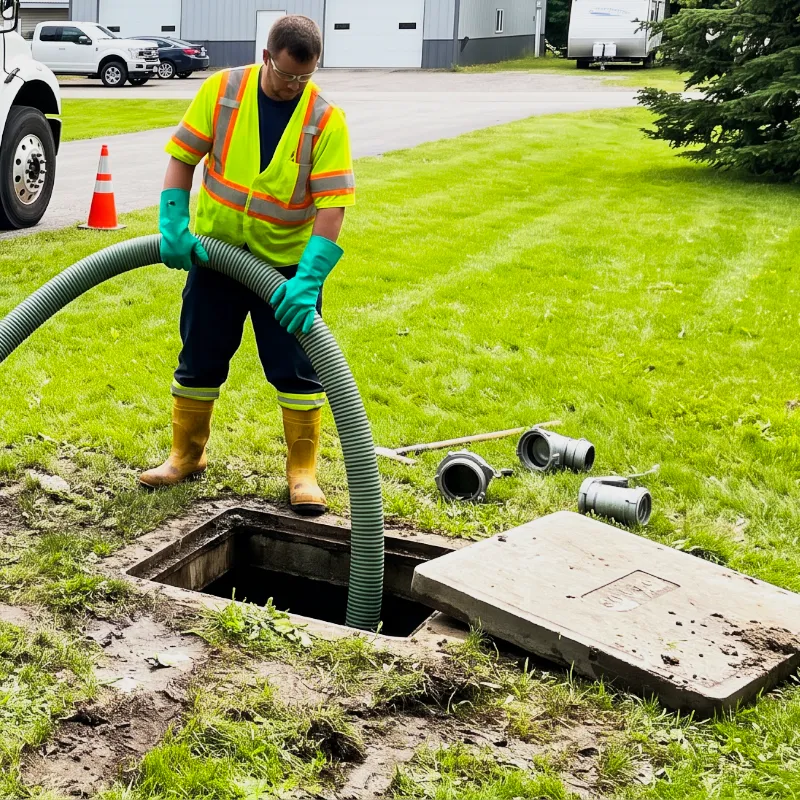
Our holding tank pumping page explains how scheduled service works, and holding tank pumping in Harrison covers the Calumet County side.
Owner Tips
How to Reduce Holding Tank Pump-Outs
This is where the holding tank vs septic tank gap hits your wallet. With a holding tank you pay by the load, and the load is water. No additive or tablet shrinks the volume in the tank. The only way to pump less often is to send less water down the drains. Here's where we'd look, in order.
Fix leaks first
The EPA says a single leaky or running toilet "can add as much as 200 gallons of water per day" (EPA). On a septic system that's a nuisance. On a holding tank it's an extra pump-out you'd never hear coming. Check every toilet and dripping tap before anything else.
Keep clean water out
Rainwater and groundwater fill a holding tank as fast as anything you flush. Wisconsin's plumbing code says storm and clear-water piping may not connect to a sanitary drain (SPS 382.36), but older homes sometimes have a sump pump or footing drain tied into the line anyway. Groundwater can also seep in around a loose riser or lid.
A simple test: if the tank fills a lot faster in April than in August with the same people living there, outside water is getting in. Tell our crew and we'll look at the riser, lid and inlet when we're there.
Spread out the laundry
The EPA suggests spreading washing machine use through the week and points out that newer high-efficiency toilets use 1.6 gallons or less per flush. Don't run a tap in winter to "keep the pipes moving," either. It fills the tank. Our guide on how to stop a septic system from freezing covers better ways to handle the cold.
Do the math once
If your house has a water meter, read it for a week. Divide the tank's working capacity (it's in the county permit file, or we can tell you after a pump-out) by your gallons per day. Example numbers only: 2,000 usable gallons at 100 gallons a day is about 20 days. Now you can book ahead instead of waiting for the alarm.
Replacement
Can You Replace a Holding Tank With a Mound or Septic System?
Sometimes. If your tank went in years ago, the holding tank vs septic tank question is worth asking again. Here's how it gets answered:
- Soil evaluation. A certified soil tester evaluates the soil on your lot and the report goes to the county. Wisconsin uses those evaluations to mark out where treatment or dispersal components can go (SPS 385).
- Permit before work. Adding or replacing a holding, treatment or dispersal component needs a sanitary permit and plan approval before work starts (SPS 383.21).
If your holding tank went in because of high groundwater or shallow bedrock, a new soil test may say the same thing. A mound builds the missing soil on top of the ground, though, so some lots that can't take a buried field can take one. Our guide to how a mound septic system works explains why. The septic system installation page covers the permit side, and our page on septic installation in the Town of Buchanan walks through a replacement. If you already have a mound that's acting up, that's mound system repair, not a holding tank job.
FAQ
Holding Tank FAQ
Does a holding tank have a drain field?
No. In Wisconsin DSPS's words, "Holding tank systems do not have a drainfield" (Wisconsin DSPS). Everything stays in the tank until it's pumped.
Holding tank vs septic tank: which is better?
If your soil and lot can support a septic tank with a drain field or mound, that's the better system to live with. It treats the wastewater on site, and the tank only needs pumping when solids build up. A holding tank is the fallback for sites that can't.
Can I pump my own holding tank?
Not in any practical sense. If your tank needs service every 12 months or less, the code requires you to keep a contract with a certified septage servicing operator (SPS 383.52), and each pump-out is reported to the county (SPS 383.55).
Read Next