
The Basics
Where a System Freezes
University of Minnesota Extension, which writes for winters a lot like ours, lists four places a septic system freezes: the pipe from the house to the tank, the septic tank or pump tank, the pipe out to the drain field, and the drain field itself (U of M Extension, seasonal care). The first one is the usual suspect, because it's often the shallowest, so that's where to start if you want to keep septic from freezing.
Wisconsin's plumbing code lets a building sewer that runs to a septic or holding tank sit as shallow as 18 inches below grade. The same section requires frost protection on a sewer less than 42 inches deep under ground where the snow stays, and less than 60 inches deep under ground that gets cleared (SPS 382.30). The state's own code treats plowed ground as needing far more protection than snow-covered ground. Snow is insulation.
Extension also points at the small stuff. A leaking toilet or showerhead "sends a small trickle of water to the system," and a trickle doesn't carry enough heat to keep a pipe open. The same goes for a faucet left dripping on a cold night to protect the water pipes: "This constant, low flow of water can cause septic system freezing." Open or uncapped risers and inspection pipes let cold air straight into the system.
Green Bay's 30-year normal is 55.6 inches a season, most of it falling in December, January and February (Wisconsin State Climatology Office). A normal is an average, though. A cold stretch with bare ground is when frost gets its head start.
Scheduling
Fall Jobs That Keep Septic From Freezing
Do these between September and freeze-up, while the ground is still soft.
- Let the grass grow. Extension suggests you stop mowing over the tank and drain field around mid-September, so longer grass catches and holds snow.
- Pump early if you're due. Oconto County, just up the bay from Brown County, tells residents that holding off on pumping until late fall raises the chance of a freeze, and to add insulation over the tank if it can't be pumped until then (Oconto County FAQ). If your county notice or last service says you're due, book it for summer or early fall. Our septic tank pumping page covers that visit.
- Mulch a new system. A system put in late in the year often has no grass yet. Extension recommends 8 to 12 inches of mulch, such as straw or leaves, over the pipes, tank and drain field.
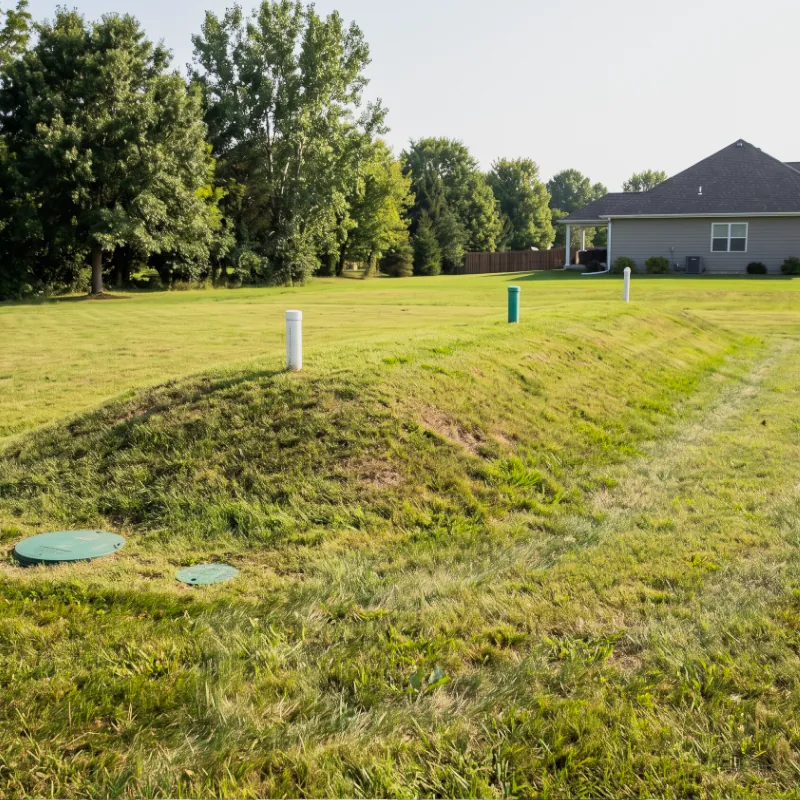
- Cap and mark your lids. Make sure every riser, inspection pipe and manhole has its cover on (Extension). Then put a tall stake by each lid so you, and whoever plows your driveway, can find it under two feet of snow.
- Fix leaks now. A toilet that runs after flushing is a winter trickle waiting to happen.
Owner Tips
All Winter: Leave the Snow Alone
Once the snow comes, most of what it takes to keep septic from freezing is leaving things be. Don't plow snow off the tank, the line or the drain field, and don't pile plowed snow from the driveway on top of the field either. Keep cars, trucks, ATVs and snowmobiles off the whole system. Extension's reason is simple: "Compacted snow will not insulate as well as un-compacted snow," and driving over the system "sends the frost down deeper."
Use water the way you normally would. Extension suggests spreading laundry out to about one warm load a day instead of saving it all for Saturday. Don't leave a tap running to "keep it from freezing," though. Extension warns that water left running all the time will hydraulically overload the system, and on a holding tank it just fills the tank faster.
The Basics
Mounds, Pump Chambers and Holding Tanks
Do mound systems freeze? They can, and the same rules that keep septic from freezing apply: long grass going into winter, snow left in place, no traffic. Our guide to how a mound septic system works covers mound care through the winter in more detail.
A mound or pressure system has a pump chamber that sends effluent out in doses through small pipes. Those pipes stay clear only if they empty after every dose. Extension puts it this way: when the pump shuts off, "all the effluent drains back into the tank through a weep hole," and it names check valves that don't let effluent drain back as a winter problem. Water left standing in the line is what freezes. If one of those pipes freezes, the pump can't move water, the chamber fills, and the high-level alarm sounds. A tripped breaker or a worn-out pump does the same thing, so check the breaker first, then cut water use and call us. Our article on a septic alarm going off walks through the other causes. For the mound itself, see mound system repair, and our Suamico mound system page explains pump chamber service.
A holding tank has no drain field, so in winter it's the inlet line and the tank lid you're protecting. Leave the snow on the line. Clear only a small spot at the lid when a pump-out is due, so our crew can get to it without digging.
Local Rules
Cabins and Seasonal Homes
A lake cottage or a hunting cabin is the hardest place to keep septic from freezing, because nobody's sending warm water into it for weeks at a time. Extension says it plainly: when a place sits empty, "no sewage is entering the system to maintain sufficient temperatures to avoid freezing." Oconto County gives the same reason for requiring maintenance on cottages used only a few times a year: a freeze can break parts in the tank or the drain field (Oconto County FAQ).
Before you close up:
- Gone for a while. Extension suggests having someone come by and use enough water in the house regularly.
- Weeks or months away. Extension warns that a tank left full for several winter months can get very cold in a shallow tank and even freeze, so pumping before you leave may help. Ask us first, though. In wet ground an empty tank can be pushed upward, which is why code requires tanks in saturated areas to be installed to prevent flotation (SPS 383.43). We'd want to see your site first.
- Do the fall jobs anyway. Long grass, mulch on a new system, covers on, lids staked, leaks fixed.
- No antifreeze in the septic system. Extension says not to add it.
Seasonal use doesn't take a cabin out of your county's maintenance program. State code does let a county stretch the inspection interval to five years for occasionally occupied buildings, by ordinance, once the county has finished its system inventory (SPS 383.54). Ask your county whether it has done that before you count on it.
Safety First
If It Freezes Anyway
You'll usually know because drains slow down and then stop, or a system alarm sounds.
Don't:
- Pour antifreeze, salt or a septic additive down the drain.
- Build a fire over the tank or drain field to thaw it. Extension says no, and so do we.
- Pump sewage out onto the ground to buy time. Surface discharge is one of the things Wisconsin law counts as a failing system (Wis. Stat. 145.01(4m)).
- Open the tank and lean over it. Tanks can hold dangerous gases (EPA).
Do:
- Stop using water except for what you can't skip.
- Call an onsite professional. Extension lists that as the first step (U of M Extension). Our crew finds where the ice is and clears the line. Our page on emergency septic repair in Little Chute covers frozen lines, and emergency septic service covers the rest of the Fox Valley. Call (920) 241-6573.
- Once it's running, find out why it froze. Thin snow, a leak or compacted ground will do it again next winter, and fixing that cause is how you keep septic from freezing the second time around.
A system that froze deserves a look once the ground thaws. Our guide to septic trouble after rain and snowmelt covers what spring can bring.
FAQ
Winter Septic FAQ
Should I leave a faucet running so my septic doesn't freeze?
No. A tap left running overloads the system and fills a holding tank faster, and Extension warns that even a slow drip can freeze the line. Normal use, with warm loads spread through the week, works better.
Does snow on the drain field help?
Yes. Undisturbed snow is the cheapest way to keep septic from freezing. Leave it, and keep traffic off it.
Can I put antifreeze in my septic tank?
No. Extension says not to add antifreeze, salt or septic additives to the system.
Can a septic tank be pumped in winter?
Yes, if the lid can be found and reached, which is why staking lids in the fall matters. Summer or early fall is still the better time if you have the choice.
Read Next