
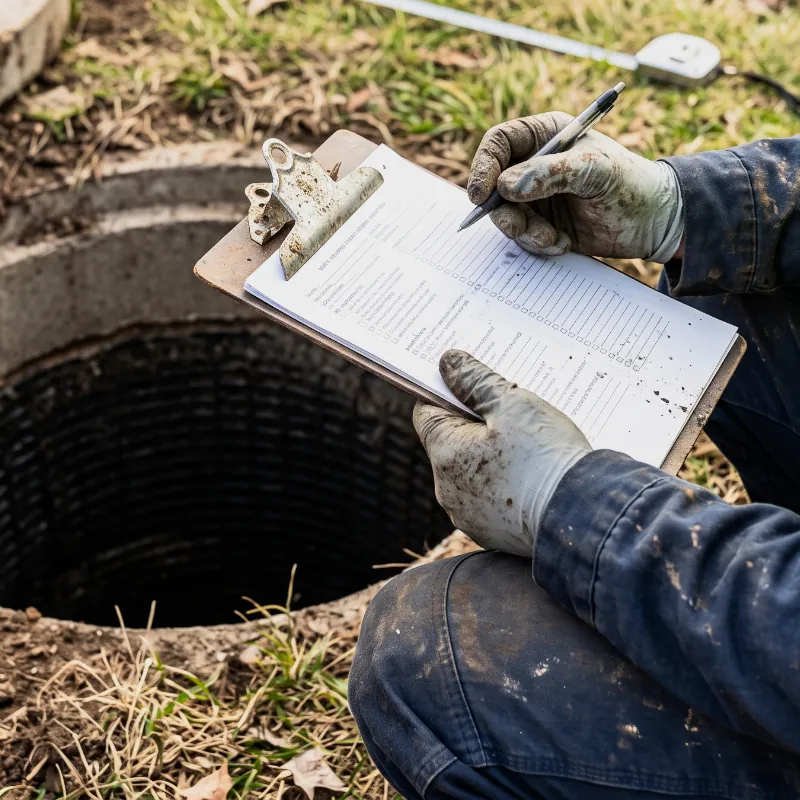
The Myth
"The State Makes You Pump Every Three Years"
We hear this on almost every job. It isn't part of Wisconsin septic pumping law, and the state agency that writes the rules says so: "Code only requires that systems be visually inspected at least once every three years," and "the common misconception that the tank must be pumped every three years is incorrect" (Wisconsin DSPS).
The mix-up makes sense. County notices come on a three-year cycle, and with the truck already in the driveway, plenty of owners pump at that visit. It's a sensible habit. It just isn't the state rule. Even the statute behind the county programs says they must require "inspection or pumping" at least every three years for systems without a state-approved maintenance plan (Wis. Stat. 145.20).
One catch: your county can ask for more than the state does. Winnebago County does, as the county section below shows.
The Code
What SPS 383.54 Actually Requires
Wisconsin calls septic systems POWTS (private onsite wastewater treatment systems), and the maintenance rules sit in SPS 383.54.
The one-third rule
A septic tank has to be serviced "at least when the combined sludge and scum volume equals 1/3 of the tank volume" (SPS 383.54(3)(b) and (4)(a)). Sludge settles on the bottom. Scum is the grease and light solids floating on top.
Under Wisconsin septic pumping law, that's a trigger, not a calendar. A big household with a small tank can hit one-third well before three years. A couple with a large tank may be nowhere close. The only way to know is to open the tank and measure. For a rough idea, the EPA says household tanks are typically pumped every three to five years (EPA).
The three-year visual inspection
The only "every 3 years" in SPS 383.54 is in (4)(d). A system that existed before July 1, 2000, and uses natural (in-situ) soil in its treatment or dispersal area "shall be visually inspected at least once every 3 years" for wastewater ponding on the ground. Newer systems get their schedule from the management plan approved with the permit. In practice every system is in its county's tracking program and gets notices (Wisconsin DSPS), so plan on a three-year visit whatever the age of your system.
For cabins and other occasionally occupied buildings, a county that has finished its system inventory may extend that visual inspection to as long as five years, but only by ordinance (SPS 383.54(4)(d)3). It isn't automatic, and the one-third rule still applies. Ask your county before counting on it.
Mounds, ATUs and holding tanks
Under Wisconsin septic pumping law, mounds, aerobic treatment units (ATUs) and other components follow their approved management plan, or for older components, the manufacturer's or designer's requirements (SPS 383.54(1), (3)(a) and (4)(c)). If the plan calls for service every 12 months or less, you need a service contract (SPS 383.52(1)(c)). Your county permit file should have a copy of the plan.
A holding tank never drains, so it has to be pumped "at least when the wastewater reaches a level of one foot below the inlet invert of the tank" (SPS 383.54(3)(c) and (4)(b)). That can be every few weeks. The high-water alarm tells you it's close. See holding tank pumping for scheduled service.
Inspect or Pump
Inspection and Pumping Aren't the Same Job
| Job | What it is | Counts for the county? |
|---|---|---|
| Visual inspection | A qualified person walks the drain field or mound looking for effluent on the surface (383.54(4)(d)) | Yes, once reported |
| Maintenance inspection | Lids off. Sludge and scum measured, baffles and effluent filter checked, plus the pump chamber, floats and alarm on a mound | Yes, once reported |
| Pumping | A licensed pumper empties the tank. Required at one-third | Yes, once reported |
| Your own look around the yard | Soggy spots, sewage smell, slow drains | No, but keep doing it |
A pump-out usually includes a look at the tank, since it's open anyway. An inspection doesn't always end in pumping. If the tank measures under one-third, the report says so and you're set until next time.
Who's allowed to do it
Wisconsin septic pumping law spells out who may do the work, and a homeowner isn't on the list unless they hold one of these licences. The three-year visual inspection may be done by (SPS 383.54(4)(d)2):
- licensed master or journeyman plumbers, including restricted-service licences
- certified POWTS inspectors
- certified septage servicing operators under DNR rule NR 114
- registered POWTS maintainers
Tank pumping is done by licensed pumpers under NR 113 and NR 114 (note to SPS 383.54). Elite Septic Fox River is licensed to pump, inspect and service POWTS in Wisconsin. Our POWTS inspections page lists what we check, and septic tank pumping covers the pump-out.
Your Notice
Got the County Letter? Do This
- Read the whole thing. Note the due date, the parcel number and what the county asks for. Some want an inspection report; some want proof of pumping under their own ordinance. Your letter is the final word for your property.
- Think back to your last service. If the tank was pumped or inspected recently, the report probably never reached the county. Ask the company that did it to send it in.
- Send a report, not a receipt. A report must include the system's identifying number and location, the date, and the licence, certification or registration number of whoever did the work (SPS 383.55(3)). An invoice usually doesn't.
- Book before the due date. The owner or the owner's agent, often the company that did the work, reports it to the county within 30 days, in the way the county specifies. The owner stays responsible if it never arrives (SPS 383.55). When our crew pumps or inspects your system, we do that paperwork and send the report to your county for you. If someone else does the work, ask who's filing. Either way, keep your copy.
If the house is on city sewer now or the tank was abandoned, call the county instead. The letter may be based on old records.
Ignoring it doesn't work. Counties send reminders and follow up on delinquent properties (Wisconsin DSPS), and under Wisconsin septic pumping law a system that isn't maintained as required is treated as a "human health hazard" (SPS 383.52(2)). We won't guess at fines, because they vary by county. The inspection is the easy part.
Local Rules
The Four Fox Valley Counties
Wisconsin septic pumping law sets the floor, and each county runs its own program on top of it. Here's what we could confirm. Anything else, ask your county office.
| County | Who runs it | What we confirmed |
|---|---|---|
| Brown | Planning & Land Services, Zoning | Existing-system inspection and holding tank forms are on the county's POWTS forms page. Check with Brown County for its notice process |
| Outagamie | Development & Land Services | Administers sanitary systems (Outagamie County) |
| Winnebago | Zoning Department | Its three-year maintenance includes pumping the tank and cleaning any effluent filter, a county rule stricter than the state code (Winnebago County) |
| Calumet | Planning, Zoning & Land Information | Pumpers and POWTS maintainers file reports in Ascent Permit Management, where owners can look up their history (Calumet County) |
Some communities cross county lines. Kaukauna is mostly in Outagamie with a small part in Calumet, so check your tax bill for your county. Local detail: Bellevue POWTS inspections (Brown) and Kaukauna septic inspections (Outagamie).
FAQ
Questions About the Three-Year Rule
Do I have to pump my septic every 3 years in Wisconsin?
Not under Wisconsin septic pumping law. The tank must be serviced once sludge and scum reach one-third of its volume, and the system inspected at least every three years. Your county can require more, so read your notice.
How often should a septic tank be pumped in Wisconsin?
Whenever it measures one-third full. For many homes that lands near the EPA's typical three to five years, but tank and household size change it. Holding tanks are pumped at one foot below the inlet.
Can I inspect my own septic system?
Keep an eye on it, yes. But the county needs a report from a licensed plumber, certified POWTS inspector, certified septage servicing operator or registered POWTS maintainer.
Does the three-year rule apply to my mound or ATU?
Those follow their management plan, which may call for service more often. If it's every 12 months or less, you need a service contract.